
The 2 Most Important Ways to Save on Property Taxes in Austin, TX

Why You Must Protest Your Property Taxes Every Year
As an Austin homeowner, navigating property taxes can feel overwhelming. However, understanding a few key strategies can save you thousands of dollars. The absolute most important step you can take is to protest your taxes every single year, no matter your situation. If everyone disputed their taxes, the overall burden would be lower for the entire community. Currently, only about 30% of homeowners take the time to protest.
Many homeowners believe that if they are planning to sell, protesting is unnecessary. In reality, disputing your taxes helps the future buyer and keeps neighborhood values fair. Here is a crucial detail most people miss: protesting targets your appraised (market) value, not your assessed value. Even if exemption caps are already holding your assessed value down, a successful protest forces the county to start from a lower baseline the following year. It also directly benefits neighbors who do not have exemptions.
You also need to understand how the Homestead Cap actually works. The cap for new homeowners does not truly kick in until year three, not year two as many assume. You will see a drop in taxable value in year one from the exemption itself, saving you roughly 5 to 7 percent. However, the full 10% annual cap on assessed value increases does not apply until year three. That is exactly why you need to aggressively fight your values during those first two years.
Maximize Your Savings: File Every Exemption You Qualify For
The second most important way to save is by filing your homestead exemption and every other exemption you qualify for. It is much easier to file right after you purchase your home. Beyond the standard homestead exemption, you may be eligible for several others:
• Over 65: Freezes school taxes and adds an additional $60,000 exemption on top of the standard homestead.
• Disabled Person: Offers the same benefits as the Over 65 exemption. Note that you must choose one or the other, not both.
• Disabled Veteran: Applies to any property and is transferable to a surviving spouse. Veterans with a 100% disability rating pay zero property taxes in Texas, and partial disability ratings still qualify for significant savings.
• Surviving Spouse Exemptions: Available in several situations, including spouses of first responders killed in the line of duty.
• Inherited Residence: If you inherited your primary home through a will, transfer on death deed, or intestacy, you may still qualify for 100% of the homestead exemption, even if there are co-owners.
• Solar or Wind Energy Devices: Added value from solar panels or wind energy equipment for on-site use may be exempt from property taxes.
⚠️ Important Warning: Exemptions can be lost, and the county does make mistakes. Title changes, moving your principal residence, or a simple clerical error can cause an exemption to quietly disappear from your account. State law only allows retroactive corrections for up to two years. Check your exemptions annually to ensure you are not leaving money on the table.
How the Homestead Cap Actually Works
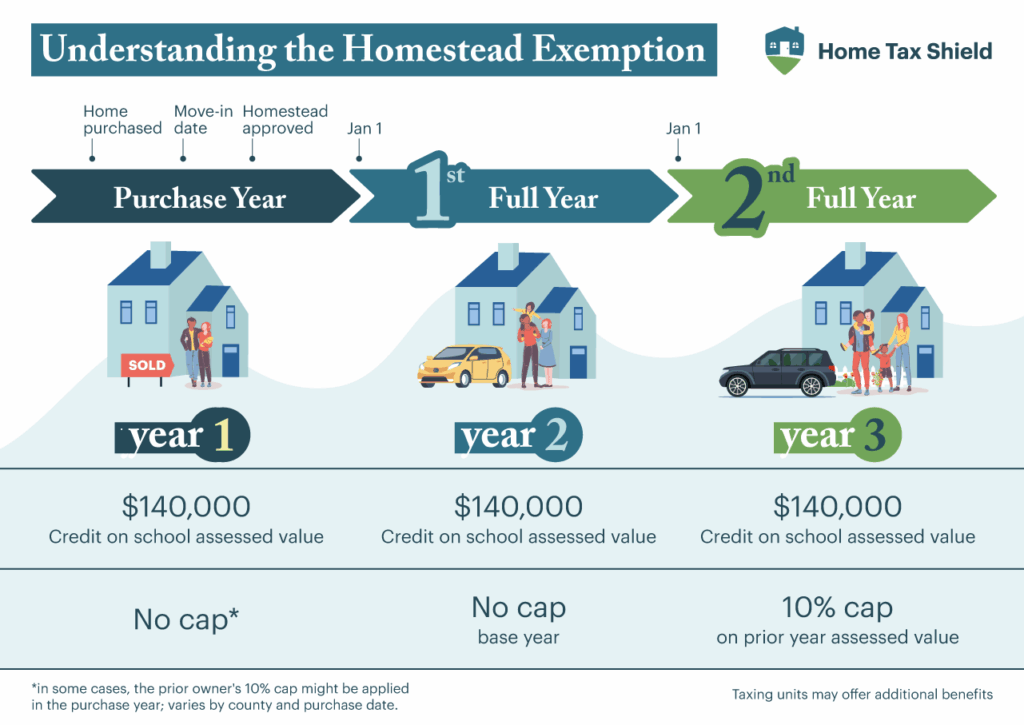
The homestead cap for new homeowners doesn’t truly kick in until year 3 – not year 2, like many people assume. You will see a drop in taxable value in year 1 from the exemption itself (saving you roughly 5–7%), but the full 10% annual cap on assessed value increases doesn’t apply until year 3. That’s exactly why you need to be fighting your values aggressively those first two years.
Property Tax Myths Busted
Do not fall for these common misconceptions:
• Myth: “I have a homestead exemption and do not need to protest.” Fact: If your value went down and you did not protest, you just agreed to the capped amount. Protest every year.
• Myth: “My noticed value is less than market value, so I am fine.” Fact: If your value does not increase by more than $1,000, the appraisal district is not required to send a notice. Check your value annually so May 15 does not sneak up on you.
• Myth: “I have the over 65 exemption and do not need to protest.” Fact: The over 65 exemption only freezes your school taxes. Other portions of your tax bill can still increase.
• Myth: “A CMA is a good tool to fight property taxes.” Fact: Texas is a non-disclosure state. Submitting a CMA hands proprietary sales data to the county, which can be used against you later. Avoid it.
• Myth: “My neighbor has a lower price per square foot, so the county should lower mine.” Fact: The county uses completely different data points, not price per square foot.
• Myth: “My house needs paint and a new A/C, that should lower my value.” Fact: Only major items like roof replacement or significant foundation repairs are typically considered.
• Myth: “E-protest is easy, I will just do that.” Fact: The county loves e-protests because they know you are unrepresented and more likely to accept a minimal reduction.
| Date | Property Tax Action / Event |
|---|---|
| January 31 | Deadline to pay property taxes |
| April 1 – 15 | County sends preliminary value notices |
| May 15 | Deadline to file a property tax protest |
| June – July | Protest hearings take place |
| November | Property tax bills are mailed to homeowners |
Get Professional Help With Your Property Tax Protest
Because the protest process requires gathering accurate data, preparing documentation, and attending hearings, many homeowners choose to have professionals handle it. Doing it on your own, especially through the county’s e-protest system, puts you at a disadvantage.
There are several companies that offer protest services, but Home Tax Shield is the one I personally use and refer to my friends and family. They thoroughly review your property’s assessment and handle the entire protest process using local market data and AI technology to ensure your home is valued fairly.
As your trusted Austin mortgage lender, the Josh Brown Team is dedicated to helping you make confident home financing decisions, whether you are buying, refinancing, or looking for ways to reduce your homeownership costs. If you need assistance with your mortgage or want to discuss your financial options, reach out to us today.
• Email: Josh@JoshBrownTeam.com
• Call or Text: 512-776-1413
• Add me to your contacts: Digital Business Card
• Apply Online: www.JoshBrownTeam.com
Q1: Does having a homestead exemption mean I do not need to protest my property taxes?
No, you should still protest every year. If your property value goes down and you do not protest, you are simply agreeing to the county’s capped amount. Protesting forces the county to start from a lower baseline the following year.
Q2: Can I use a Realtor’s CMA to fight my property taxes in Texas?
It is highly discouraged. Texas is a non-disclosure state, meaning sale prices are not public record. Submitting a Comparative Market Analysis (CMA) hands proprietary sales data over to the county, which they can use against you in future assessments.
Q3: When does the 10 percent homestead cap actually take effect?
The full 10 percent annual cap on assessed value increases does not apply until your third year of homeownership. While you will see a drop in taxable value in year one from the exemption itself, it is critical to aggressively fight your values during the first two years.
Q4: Will routine home maintenance like a new AC unit lower my assessed value?
No. Routine maintenance, cosmetic updates like paint, and appliance replacements do not typically move the needle for the appraisal district. Only major structural issues, such as a roof replacement or significant foundation repairs, are considered.
Q5: What happens if the county makes a mistake and drops my exemption?
Clerical errors, title changes, or moving your principal residence can cause an exemption to disappear. Fortunately, state law allows retroactive corrections for up to two years. You should verify your exemption status annually to ensure you are not overpaying.
Ready to lower your property taxes?
Check out what a protest could look like for your home this year.
Get Started with Home Tax Shield
Schedule a Free Consultation with Josh Brown
